Study of Shedding Mechanisms in Cloud Cavitation and the scale effects on dynamics
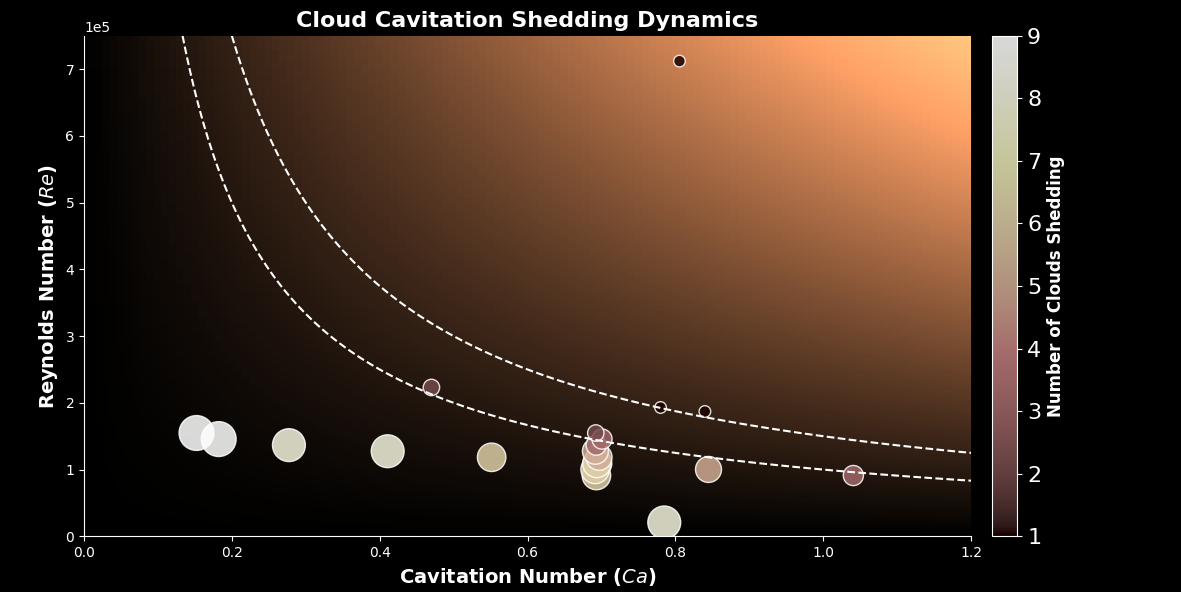
The shedding mechanisms(re-entrant jet and condensation shock) causing the cloud cavitation phenomenon are extensively studied but the dominance of a particular mechanism is not clearly understood. There are few studies in recent times that observed the presence of Kelvin-Helmholtz instability causing the cloud shedding. To get better understanding of the underlying mechanisms in our geometry, two sets of experiments were carried out. In the first one, the outlet of the Venturi geometry is left open to atmosphere. In this case, the cavity length increases and the shedding frequency decreases as the velocity increases. For the second set, a vacuum pump is used to actively control the system pressure such that same cavity length is obtained for different velocities. In this case, the frequency increases with velocity. Based on this dataset, we observed the dominance of Kelvin-Helmholtz instability in longer cavities and this leads to multiple cloud shedding rather than single cloud shedding that we usually see in bigger geometries. At the same time when we compare the highest flow rate across the two datasets, we go from 9 cloud shedding to 2 cloud shedding. This shows us that cavitation number influences the number of clouds shed. However, for the second dataset all the flow rates are at same ccavitation number but we see the number of clouds shedding decrease as we increase velocity. This implies Reynolds number also plays crucial in the number of clouds shed. To understand the dynamics transition, a new non-dimensional number called Ca.Re is introduced which is product of Cavitation number and Reynolds number. With the help of this new parameter, we were able to classify the shedding dynamics into single cloud and multiple cloud dynamics. Through this parameter, we finally know the reason why we always see single cloud shedding in bigger scales and as we go to smaller sclaes the number of shedding clouds increases. In the literature we can see that collapse of single big cloud causes more damage compared to the collapse of multiple small clouds. This new parameter can help us design systems that avoid single cloud shedding.